26
13/14
about 400,000 bags from the previous year, with experts
blaming various weather factors that had remarkable impact
especially on Robusta coffees. Masaka, which is one of the
biggest producers, experienced the driest spell midyear
2012. That year, UCDA expressed fears that the effect will
not only be realised on the newly-planted trees but also the
development of coffee berries, which indeed happened and
it greatly affected the volume of coffee produced that season.
It seems the country is back to same scenario. The dry spell
is back and if it continues like this, government’s efforts to
further grow the sector could godown the trench unless
specific interventions are put in place.
Considering the strategic importance of coffee, government
had embarked on supporting farmers to plant 100 million
higher-yielding coffee seedlings per year for the next three
years (2013/14 to 2015/16). There are fears, however, that if
the current dry-spell continues its effortsmay not be realised.
Climate change has led to the proliferation of pests
and diseases; Mr. James Ponde, a plant pathologist at
Buginyanya Zonal Agricultural Research and Development
Institute, which is located in Bulambuli District, says Climate
change has resulted into emergence of pests like the
Stem Borer and the Black Coffee Twig Borer (BCTB) that
attacks mainly Robusta coffee in Uganda; and diseases
like the Coffee Leaf Rust and the Coffee Berry Disease
(CBD). The latter has affected 75 per cent of the plants in
Bulambuli, Kapchorwa, Bukwo, Kween andBududa districts.
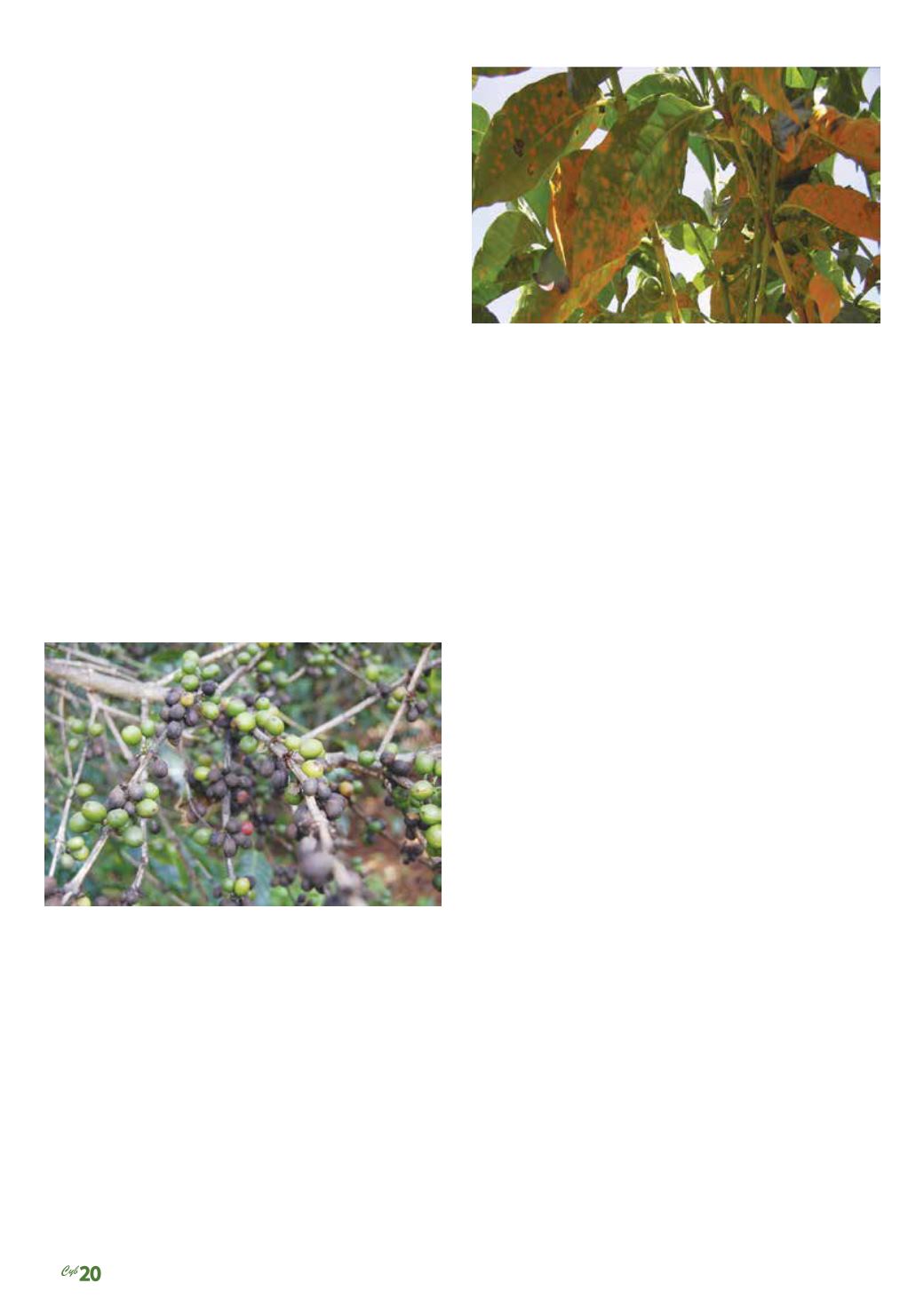
Coffeeaffectedby theCoffeeBerryDiseaseand ismore severe
inArabicas
“Initially,Coffee leaf rust diseasewasknown tobe foundbelow
1,500 metres above sea level but is now attacking coffee
grown at higher altitude of 1,800metres above sea level and
this is attributed toclimatechange,” saysMr. Ponde. Headds
that since it attacks the leaves, loss in yieldscanbeashighas
100 per cent. However, diseases like Leaf Rust could also be
caused by poor agricultural practices like failure tomulch the
plantations and unsustained spraying regimes.
ACoffeeLeafRust infected tree
Many stakeholders at all levels of the value chain are
concernedabout thisphenomenonand their fear isnotmerely
about the disappointment for those who enjoy their caffeine
hit drink with a little more flavour and fragrance, but a global
disaster for thecoffee industry.MbaleandKapchorwa regions
of EasternUganda have got some of the best Arabicas in the
world; however the slightest variations in growing conditions,
such as changes in rainfall or temperature, can affect coffee’s
flavor (cup) and hence the value of the product. The Region
is already experiencing unprecedented levels of pests and
diseases, and is struggling todeal withunpredictableweather
conditions that are intensely affecting coffee production.
Climate change in Uganda is already having an effect on
coffee production.While long-term effects are not yet certain,
heavy rainfall, floods and landslides are already on the rise like
in Bududa and Kasese respectively. The experts expect that
extreme weather events will increase in both frequency and
intensity, affecting rainfall patterns and disrupting agricultural
practices such as reducing the amount of land suitable for
coffee production.
Mr.WillingtonWamayeye, theManagingDirectorofGumutindo
CoffeeCo-operative inMbale, says “when temperature rise, a
humid environment is createdwhich favours themultiplyingof
pests anddiseases, andwe have high levels of pest attack of
the coffee. In the past it was manageable – now it’s running
out of control and youcanseeawholegardenof plantsdrying
up. It’s like an epidemic”.
Heavy rains coupled with deforestation have also increased
the incidenceof landslides in the region,whichhasdevastated
not only coffee farms but also other crops and destroyed the
farming communities. It is estimated that in 2010 over 250
acres of coffee were buried and about 500 homesteads in
Bududawereabandonedwhen farmerssettled incamps. This
means that their farms were left unattended to, which had a
negative impact on the production.
According to a 2007 meteorological report, the average
temperature in the coffee-growing areas was at about 25
degreesCelsius.ButMr.Paul Isabirye,AssistantCommissioner,
Department of Meteorology, says due to global warming,
temperatures could have risen since the report was issued.
He points out that rain is now falling at the wrong times, and
the coffee beans have less time tomature. “If the coffee bean
is subjected to toomuch sunshineand less rain, thebean size
will be smaller and thismay lead to lower yields,” he adds.


