31
13/14
advises that stakeholders engaged in the promotion of the
coffee industry should pay attention not only to increasing
production/ productivity but should also intensify the quality
control campaigns.
Henoted that a lot of effortsand resourceshavebeen injected
into increasing the country’s production potential, with little
emphasis on quality and extension services, which are also
key ingredients in having a vibrant coffee sector. H
e
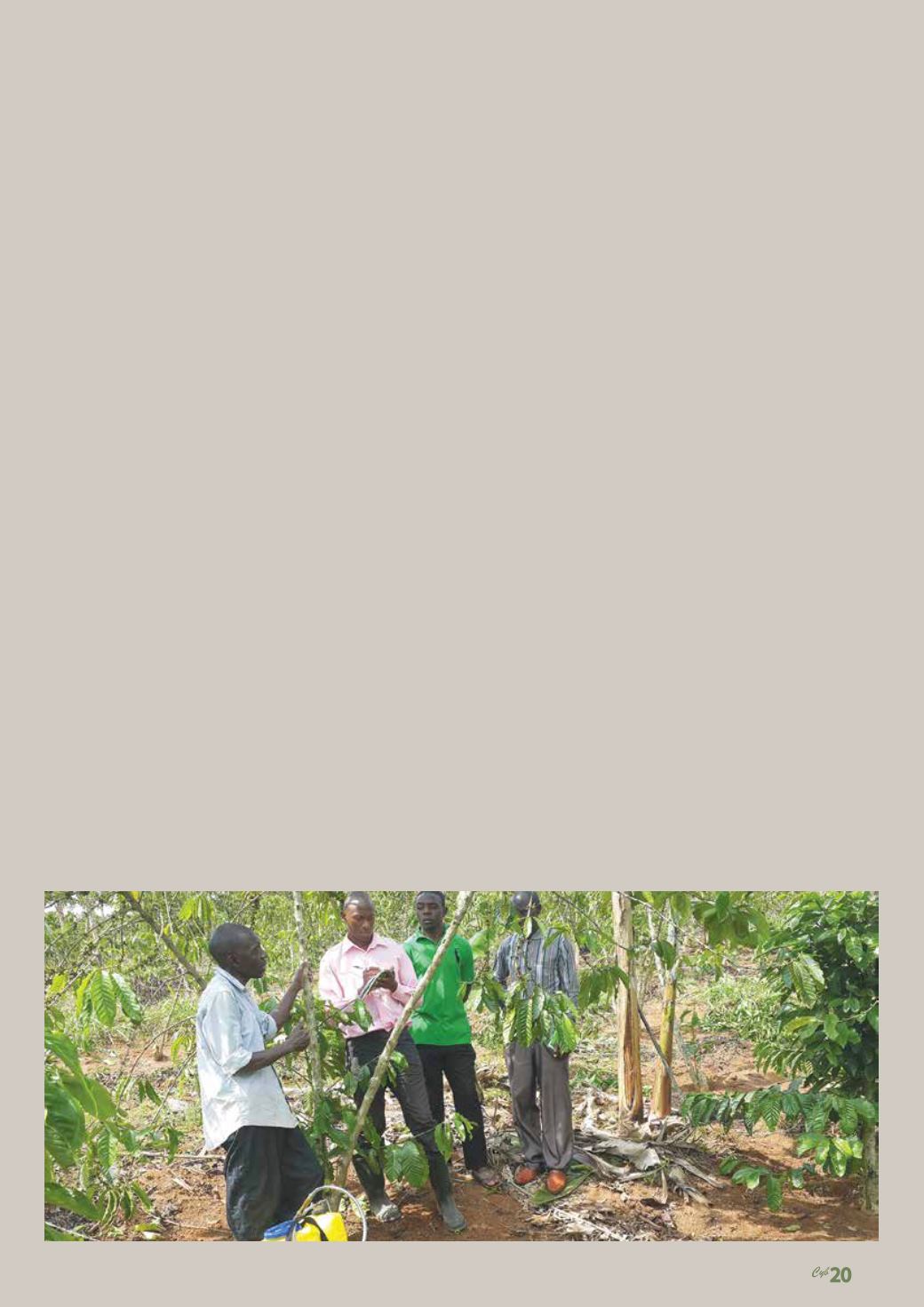
explained that Uganda’s coffee sector has declined because
there is no will from government to revamp the extension
system to teach farmers the different pests and diseases that
attack their shambas andhow to control them. He recalls that
in the late 1970’s, they used to have extension workers at
different levels right from the village, parish, sub-county and
later at the district level. “We used to have field assistants,
agricultural assistants and agricultural officers. These spent
more time with the farmers and service delivery was not
demanddriven as it is today,” he said.
Erostus Nsubuga, another prominent and respected farmer
who has mastered the art of multiplying different planting
materialsusing the tissueculture technology saysgovernment
needs to have a proper plan to revamp the sector.
He believes that the country needs to embrace the tissue
culture technology to solve the current problem of sub-
standard planting materials on the market. “Through tissue
culture farmers can be assured of getting clean planting
materials free from thediseases,” he says. Nsubugaadds that
the supply of tissue culture plantlets, regardless of quantity,
requires proper and timely knowledge of the specifications;
types, age, size and all the key components required to
comply with the weather conditions and farmers interests.
This is a process that requires advance full information on the
timeliness. However, he says his company has often been
ambushedwith impromptu orders that have turned out to be
uncomfortable especiallywhen it comes to delivery times and
types of varieties and schedules.
“We need tobe given enough time toprepare these plantlets
through the process and make them ready for delivery at
different supply points,” saysNsubuga.
He says unlike other crops whose seeds do not require
vegetative propagation, tissue culture plantlets require a very
sensitive process that has to be planned well in advance. To
have a vibrant coffee sector, Uganda Coffee Development
Authority (UCDA) requires about sh105bn in the next three
years to be able to plant 300 million coffee trees in the
countryside.
According to UCDA, the institution requires about UGX3.5bn
annually togenerate100million seedlings, sh30bn tobuy and
distribute the seedlings to farmerswhileUGX1.5bn is needed
tomonitor and supervise thedistributed seeds annually. “With
such an investment, it is hoped that after three years, farmers
will be inposition toharvest anadditional 2.2Million60kg-bags
annually valued at UGX 659.8bn. To rehabilitate the existing
coffeegardens in thecountryside theywill requireUGX49.98bn
though the government allocates only UGX400m annually.
They also require UGX5bn to control pests and diseases but
the institution receivesaboutUGX700m for thisactivity leaving
a funding gap of UGX4.3bn to address the scourge.
This financial year, they envisage to raise 96 million coffee
seedlings and 9.6 million agro-forestry tree shade. They also
plan todistribute200,000coffeewiltdisease resistantplantlets
to 285 nursery operators for multiplication. The Institution
expects to procure 1 million tissue culture seedlings, carry
out pest and disease surveillance and set up at least one
acre of land to demonstrate integrated pest management in
33 selected districts. They will also conduct demonstrations
on appropriate soil and water management practices for hilly
areas on selected 50 coffee farms. They anticipate to export
4,100 tonnes of coffee to new and emergingmarkets.
Gerald Katabazi, the founder of Volcano coffee traders, a
roasting company and exporter says the future of the coffee
industry in Uganda was on the upward trend. Having been
raised in a coffee-growing family, he was naturally drawn to
knowing more about the crop and earning from it. Katabazi
runs a coffee shop, supports farmers in different parts of the
country andmanages a coffee-roastingplant.
Before venturing into the business, he was an employee at
Café Pap, one of the busiest coffee shop in the city centre.


