51
13/14
water and in the process somewater is removed. Soon after
theharvestof the redcherry,mechanical de-huller removes the
outer layer followed by the operation known as degumming,
during which the mesocarp (the mucilage adhering to the
endocarp) is removed. The degumming operation involves
immersion of the de-hulled fruits in water for about 24 to 48
hours depending on altitude and temperature – (fermentation
period). Water used in fermentation is rich in organic matter
andpossesses highpollutant capacity and therefore needs to
be treated. Wet processed coffee is usually consideredmore
superior in quality than dry processed coffee.
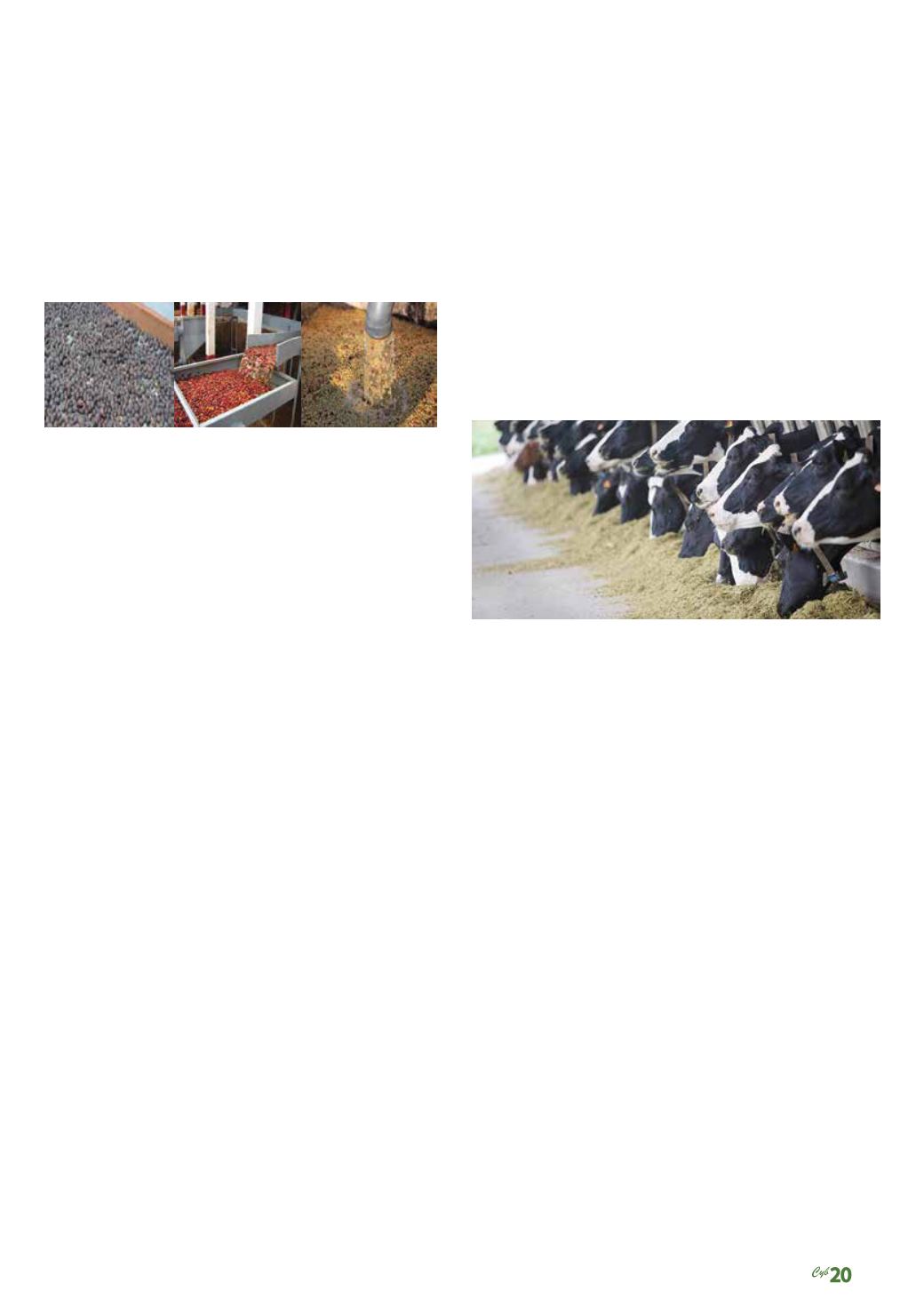
Dryprocessedcoffee (Left)Wet Processing (Middleand
Right)
Potential alternative uses of coffeewastes andby-products
Now that you know the physical structure (anatomy) of the
coffee cherry, then let’s seewhat happens to the residues.
Thereareseveral coffee residuesbut themajoronesarecoffee
pulp, coffee husks, waste water and spent coffee grounds.
Coffee husks are produced in the dry process of separation
of coffee berries while coffee pulp through wet processing.
Spent coffee grounds are produced during the processing
of raw coffee powder to prepare roast and ground coffee or
getting instant coffee.
ThePulp:
Coffee pulp is one of the most abundantly available agro
industrial waste produced during the pulping operation of
the coffee cherries to obtain coffee beans. It is estimated that
for every 2 tons coffee cherries processed, nearly 1 ton pulp
is generated (Roussos et al., 1995). However, high tannin
content prevents coffee pulp from being used widely in feed
or as fertilizers/ compost. Detoxification of coffee wastes is
seen as key to widen utilization and researchers have used
fermentation process to reduce the toxicity of thematerials.
Coffee pulp solids asCompost:
Coffee pulp solids contain about one fifth of the nutrients
taken out of the soil by export of the green bean. However, it
is a good source of humus and organic soil carbon. If coffee
pulp is turned over every few days in a heap preserved for a
few years as in conventional compost making, it will compost
in threeweeks into one fifth of the original volume of a stable
earthy smelling material which does not attract flies. Left to
mature for three months under cover, it will reduce further to
become very nice dry earthy compost which is a good soil
improver and conditioning agent. It is at the point where the
pilebegins to heat for the second time, after the first turnover,
that the collapseof structureoccurswith amassive releaseof
black sticky liquid which contains most of the nutrients and
is the real fertilizer material. This liquid should not be allowed
to flow away, it should be collected and sold as a high value
organic plant nutrition agent and pest deterrent to give an
extra source of cash flow (ICOED 1967/05).
CoffeePulpSolids toSilage:
An attempt to include coffee pulp in livestock feeding system
goes back to the early 1950s. It was reported that it has a
promising role in livestock feeding if it can be efficiently and
economically dehydrated (Quadros et al., 2003). Several
studies have been carried out on the use of coffee pulp as
food for animal (Bressani, 1987; Clifford & Ramirez-Martinez,
1991.) Coffee pulp contains proteins, carbohydrates and
minerals that favor its utilization inanimal feeding (Pandey and
Soccol, 1998) however, they have high amounts of caffeine
and tannins. Ensiling pulp with other feed resource appears
to be one way of detoxifying the anti-nutritional factors of
coffeepulp/husk (Getachewet al., 1989). Ensiling is thewidely
used for the conservation of animal feedwith high sugar and
moisture contents through controlled fermentation (McDonald
et al., 1991).
Somecoffeepulpcanbeadded toanimal feeds
Some studies show that coffee pulp can replace up to 20%
of commercial concentrates in dairy cattle feeding, with no
adverse effects on the cattle. This replacement can be
translated to a 30% cost savings. Also, feeding studies with
pigs indicated that corn couldbe substitutedwithdehydrated
coffeepulp forup to16%of the total ration,withnodetrimental
effect onweight gainor feed conversion. The net result of this
substitutionmeans that each reared pig has left nearly 50 kg
of corn available for human consumption or alternative uses.
Besidespigsandcattle, coffeepulp feeding trialswerecarried
out with fish, chicks, lambs, and rabbits. The feeding trials
included thedeterminationof daily bodyweight gain, daily dry
matter intake, and feed conversion efficiency. Pigs fed with
rations containing up to 15% of coffee pulp ensiled with 5%
molasses had equal or better total weight gain than those fed
commercial concentrates.
Coffee pulp ensilage is a valid alternative to handling and
storing the huge amounts of coffee pulp produced in the
factories around the world which process coffee cherries.
The inclusion of coffee pulp silage [CPS] in the diets of some
farm animals could contribute to lowering the meat andmilk
production costs, especially in developing countries.
CoffeeHuskas a fuel:
Coffee husks are normally fed into the furnaces and kilns
combustion flames. Huskareburnt inagasproducer, and the
engine is run on that producer gas to produce electricity for
drying. InUganda this isusedmainly inHimaCement,Uganda
Clays andEcom Trading inKapchorwa to replace the fuel oil.


