55
13/14
1,700 farmers have accessed coffee information and
knowledge related services from these centres.
Value addition has been key in aBi’ coffee intervention
endeavours to uplift the standard of Ugandan coffee
farmers; to date over 10 central washing stations
mainly eco-pulpers and several hulling facilities have
been supported. NUCAFE and Ankole Coffee Producers
Cooperative Union (ACPCU) have been supported to set up
secondary grading facilitieswith capacities of 7Metric tonnes
per hour and modern laboratories to assess quality. aBi has
continued to support productivity enhancement activities
like Good Agricultural Practices (GAP) and farmer field
demonstrations. To date 1,781 demos have been set up and
over 70,000 farmers have attended and learned from these
demonstrations.
To address the problem of clean planting materials, support
was extended to Royal Plant Nurseries ( RPNL) through a
cost share grant to especially improve access and availability
of clean planting materials through tissue culture. Clean
seedlingsareexpected tobeavailableby2015.More support
to partners to produce both elite and clonal coffee continues
tobepart of someof aBi’ interventions. aBi has supported18
nurseries incollaborationwithUCDA tomultiply theCoffeeWilt
Disease resistant (CWDr) material and over 20 nurseries with
other partners each with capacity to produce over 200,000
seedlingsperseason.This isaimedatmakingplantingmaterial
affordable and accessible to farmers. The main focus is on
establishingmother gardens and nurseries for both Elite and
Clonal coffee seedlings. At the nurseries, promotion of shade
tree seedlings productionwas taken care of under theGreen
Growth initiative tomitigateClimateChange that is negatively
impacting coffee production.
Interventions to address green growth initiatives are being
supported. Emphasis is on the five pillars of greening namely
air,
biodiversity/
ecosystems, water,
energy and soil.
Interventions include
climate
smart
agriculture, cleaner
production systems
and energy saving.
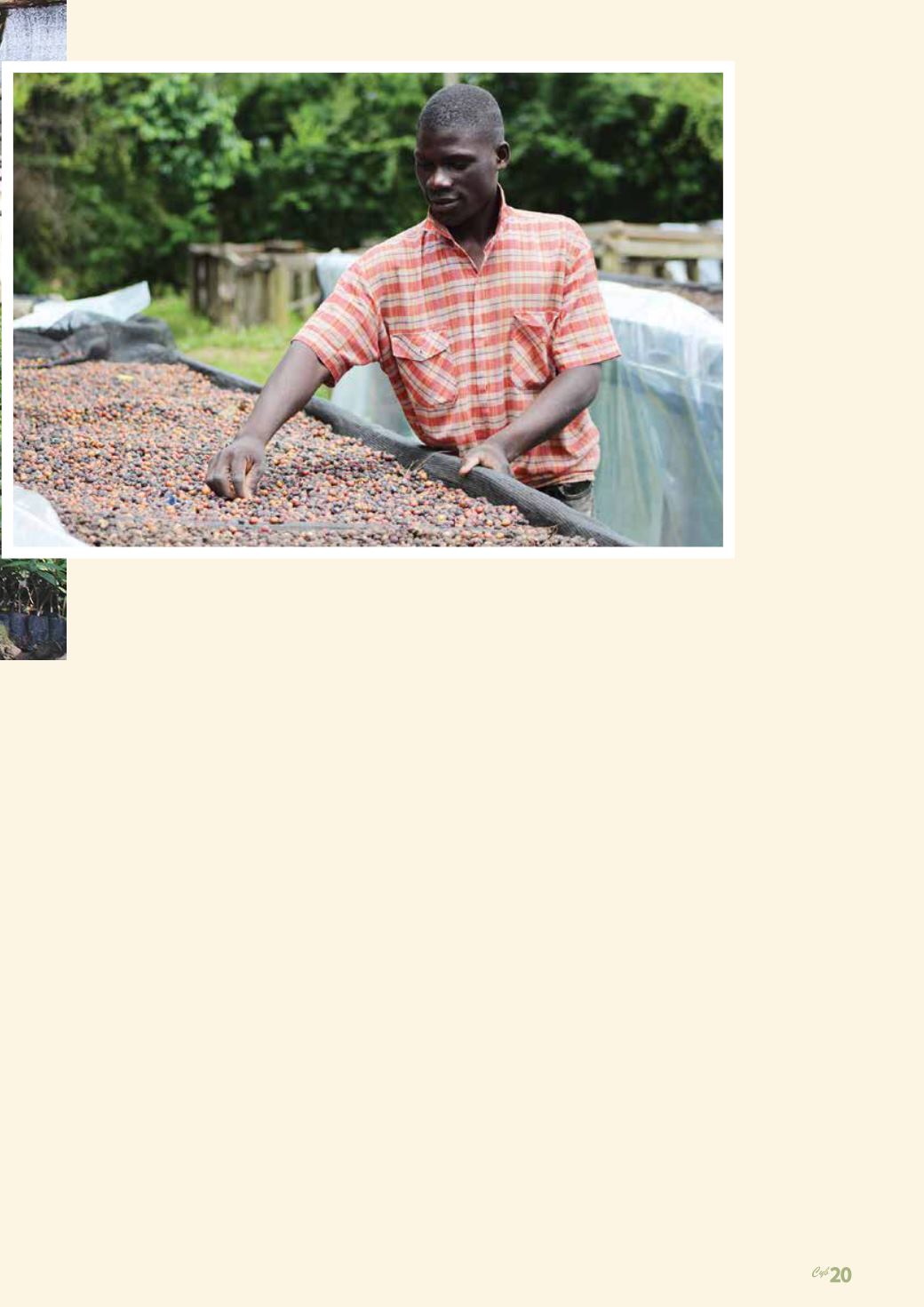
P o s t - h a r v e s t
technologies
are
promoted
and
these include drying
sheets, poly tunnels,
Grain-Pro products
and
washing
stations for Arabica
and Robusta. In
addition my-cotoxin
testing equipment
which has been
provided to some
coffee
exporters
and UCDA and
has consequently
improved the quality
of coffee.
Coffee extension materials to suite the changing trends
were needed and supports was given to the National Coffee
Steering Committee to develop/upgrade the materials and
were approved and ready for print in 2014.
At the producer level, Village Savings and Loan Associations
(VSLAs) arebeing supported throughprovisionof kits, training
and technical support.Thesehave resulted inasavingsculture
and cohesion among groups, which make adoption of other
interventions easier.
Through Financial Services Development, aBi is supporting
financial institutions to increase outreach of financial services
tovaluechainactors, includingcoffee.By increasingaffordable
responsible financing, aBi Trust creates an opportunity for a
balancebetweensocial, environmental andeconomicaspects
of the society
aBi further supports gender mainstreaming using the
household approach and Farming as a Family Business
(FaaFB) to improve the livelihoods of farmers. Many coffee
households have improved their incomes as the result of
increased production/productivity and quality through vision
setting, joint planning and investment.
With inclusion of Human rights based approach ( HRBA) in
project implementation aBi Trust continues to build capacity
among communities among which we work so that they
are able to meet their needs while living responsibly and
accountable livelihoods.
It therefore evident how the strategic interventions by aBi in
the coffee sector contribute to redeeming this lucrative sector
whose export potential is not fully exploited coupled with
being constrained by limited production at farm level, to the
detriment of the economy.


