57
13/14
their significant importance in the chain, their willingness to
buy the coffee seedlings, projected demand, challenges and
opportunities and measures to ensure sustainability for the
coffee plantingmaterial trade.
Production and distribution of planting materials by
NaCORI
The National Coffee Research Institute (NaCORI) at Kituuza
has the mandate to carry out research on coffee and cocoa
in the country. The Institute has been central in the coffee
research development efforts in the country. It develops
technology packages aimed at solving practical problems in
the industry. The most recent is the coffee wilt disease that
destroyed millions of coffee trees in the country. Scientists
at the institute spearheaded the development of 7 coffee wilt
disease resistant (CWD) tolerant lineswhichareat thestageof
multiplication anddistribution.
Existingcapacityof NaCORI
This Institute was a coffee research centre (COREC) under
National Agricultural Crop Resources Research Institute
(NaCRRI). The research centre was upgraded to a fully-
fledged National Coffee Research Institute (NaCORI) in 2013
with a sub-station at Bugusege in Sironko district that caters
for high altitude coffee (Arabica) research. The institute has
one plant breeder, one pathologist, a couple of technicians
and support staff. The upgrading of Kituuza is expected to
boost the operations of the research institute particularly on
coffee and cocoa. The institutedoes not have a tissue culture
laboratoryof itsownandpresentlysharesoneatKawandawith
other programs. This has posed several challenges ranging
from the distance to the current tissue culture laboratory at
Kawanda, lack of control over staff, old laboratory equipment
and few staff. Thecoffeenursery screenhousesat the station
need rehabilitation as the twomajor nurserieswere destroyed
by wind and no effort has been made to rehabilitate them.
There are two mother gardens of CWD tolerant materials at
the station, fromwhich cuttings are propagated into plantlets
and supplied to UCDA for onward distribution to nursery
operators andmother garden establishment.
During theperiodof thestudy,NaCORI advertised forpotential
bidders to construct a new and modern tissue culture
laboratory at the station. Constructionof a new tissue culture
laboratory is nowunderwaywith financial support fromUCDA
to enhance the ultimate goal of improving coffee research
performance and multiplication of coffee planting materials.
The total cost of constructing the tissue culture laboratory
was estimated at UGX4billion. It is projected that this facility
will produce about 10 million planting materials per year at
maximum capacity.
Distribution/allocationof plantingmaterials
Research and development of coffee wilt disease resistant
lines was initiated early in 2000 with a resultant release of
7 CWD tolerant lines in 2006. The institute established
mother gardens and subsequently started producing CWD
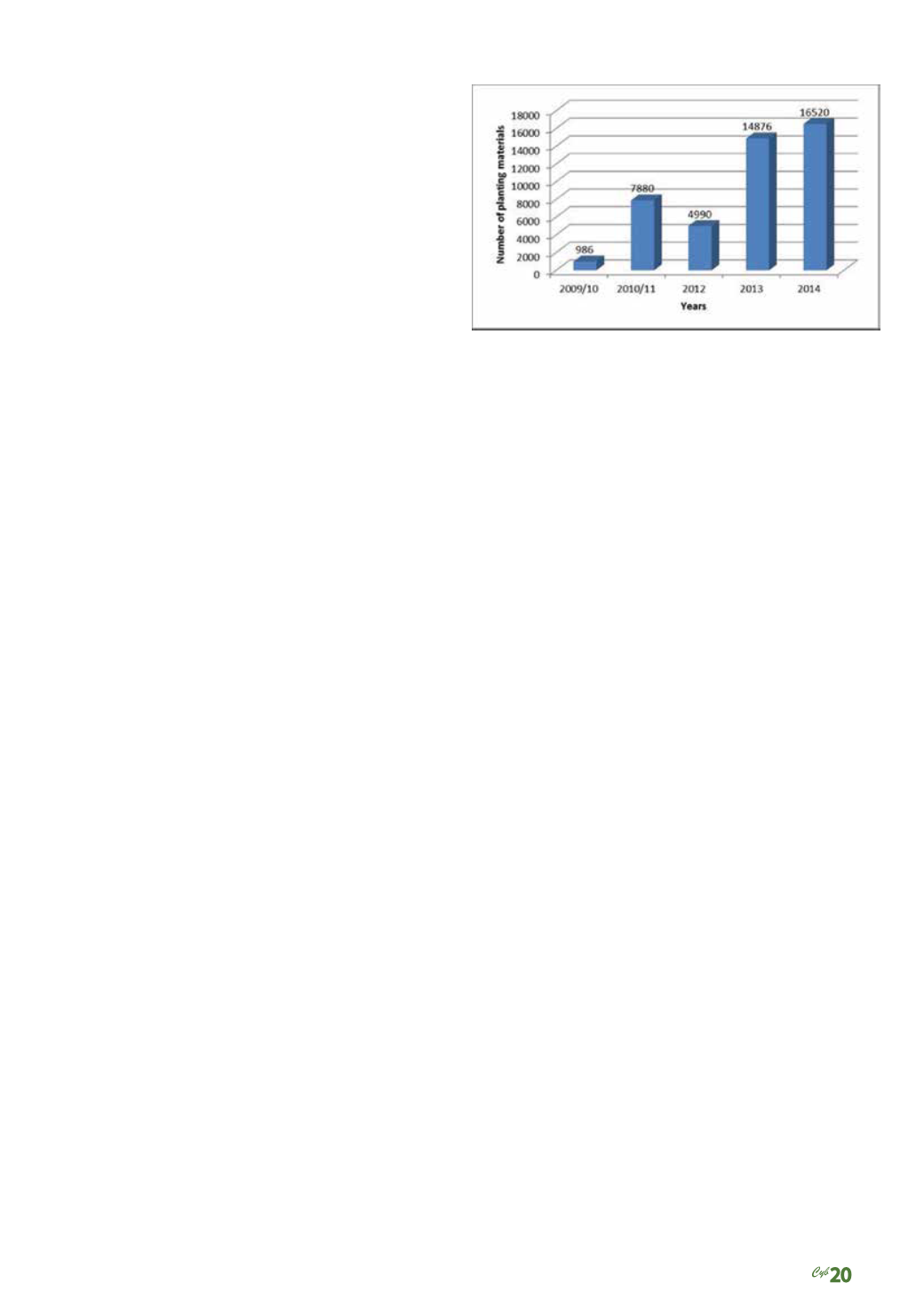
tolerant lines as presented in Figure 1. Distribution began in
2009/2010with only 986 cuttings and gradually increased to
16,520 cuttings inApril 2014 (Figure 1), with about 70% of all
thematerials produced in 2013 and 2014.
Figure1:Coffee seedlingsdistributedbyNaCORI
Source: NaCORI 2014
For the last five years, NaCORI produced and delivered a
total of 45,252 CWDr plantingmaterials to nursery operators
through UCDA for establishment of mother gardens of which
25,000coffeeplantingmaterials (55%)weredeliveredas tissue
culture plantlets and a balance of 20,252 planting materials
(45%) deliveredasnodal cuttings.Whileat theplanning stage,
itwasenvisaged that,multiplicationof the7CWD tolerant lines
wouldbeenhancedbyuseof the tissueculture technique, this
objectivehasnot been realizeddue toanumber of challenges
as outlinedbelow.
(i)
Delays in developing proper propagation protocols
for in vitro regeneration of plantlets, hardening and
weaning difficulty. To date clones KR4 andKR5 have
respondedpoorly to all the developedprotocols.
(ii)
Lack of a tissue culture facility dedicated to coffee
sector development because what is available at
Kawanda is dedicated to banana propagation and
other researchmaterialsat the institute, and it isnot a
commercial-scale laboratory.
(iii)
Limited number of trained staff in tissue culture
techniques and tree crop propagation that are under
the full supervision of theNaCORI research team
(iv)
Limited funding of the institute has hampered public
research, leaving established private tissue culture
laboratories to engage in research anddevelopment.
(v)
Power interruptions during key propagation stages
which leads to highmortality rates.
Based on the number of planting materials (tissue culture
and rooted cuttings) produced and distributed by NaCORI,
an estimated total number of 129mother gardens have been
established using the CWDR coffee plantingmaterials during
the last five years as presented in Figure 2. The first three
categories of mother gardens established in 2009/2010 and
2010/11 were expected to reach productive stage by end
of 2014 and an estimated 610,800 cuttings ought to have
beenproducedbasedon theassumptionof 60%survival rate.
Within the next period of two years, production of cuttings is
expected to begin and an average annual total of 30 cuttings
per mother tree are estimated as the number a nursery
operator can harvest. Therefore, production and distribution
of theseCWD tolerantmaterials remains a big challenge to all
coffee industry stakeholders and calls for concerted efforts to
increase on their production anddistribution to farmers.


