59
13/14
pineapples are propagated.
(ii)
More resources should be directed towards
developing coffee research with the intention of
funding infrastructure (laboratory, water systems and
weaning/hardening facilities), routine activities and
trainingof staff.
(iii)
The National Coffee Platform should discuss
modalities to support NaCORI carry out research and
share findingswith industry stakeholdersat anominal
fee to supplement her resources.
(iv)
NaCORI has the mandate of gathering, maintaining
and storing coffee genetic plant materials. It should
establish multi-location mother gardens to minimize
the risk of destruction and utilize biotechnology
techniques topreserve the coffee germplasm.
(v)
NaCORI through strong collaboration with the
private sector should breed coffee varieties that have
characteristics as demandedby themarket.
Productionanddistribution
of coffeeplantingmaterialsby
nurseryoperators
The training and certification of all nursery operations in the
country is a responsibility of UCDA in addition to confirming
supply orders specifying the number of planting materials to
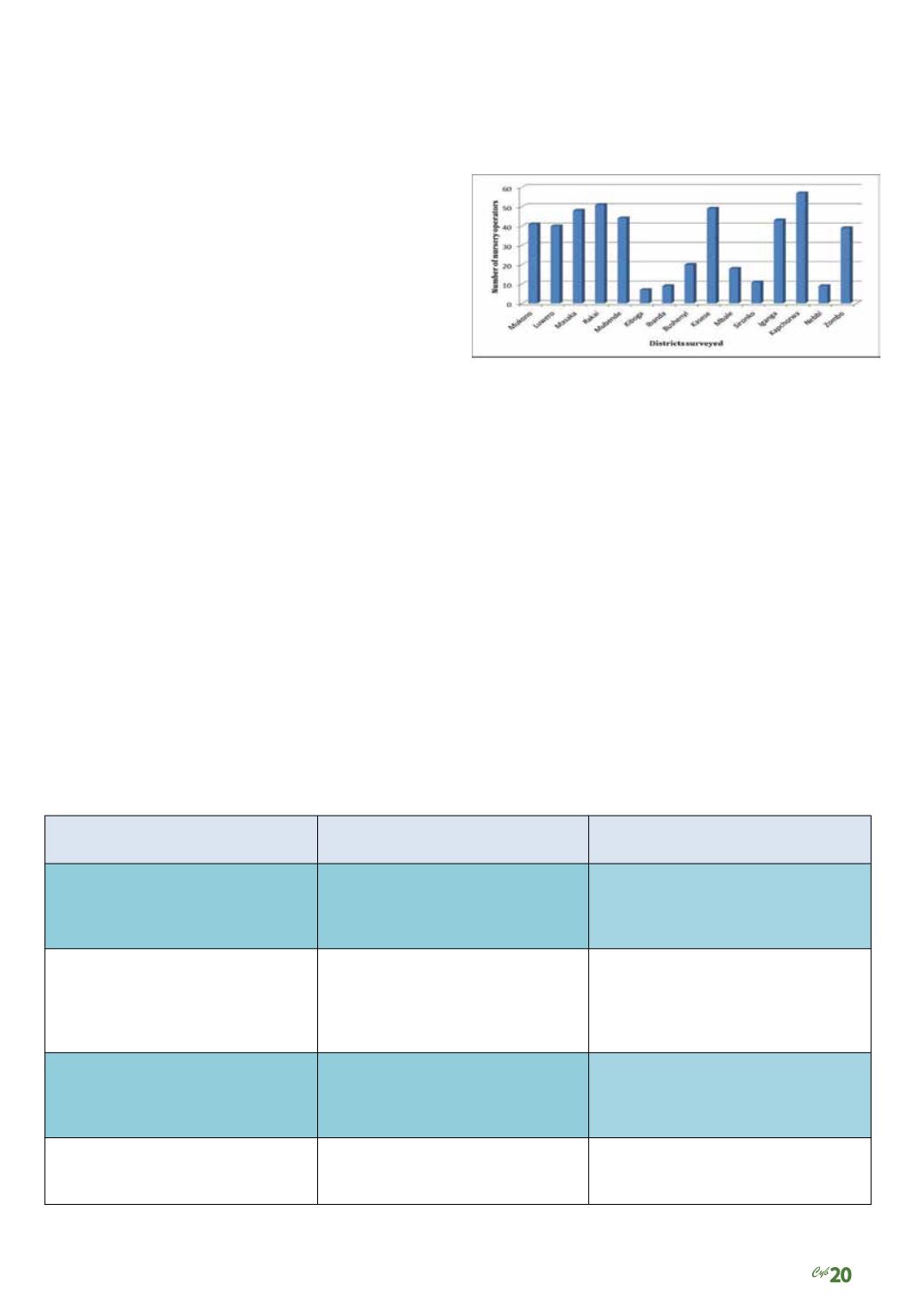
be delivered during a given season. Figure 3 presents the
number of coffee nurseries in the districts covered during the
study. All the coffee planting materials produced were either
elite (98%) or nodal cuttings (2%). TheCWD tolerantmaterials
so far produced by NaCORI are still at nursery level and are
grown todevelopmother gardens throughout the country.
Figure 3: Nurseries in the study area
Source: Survey data 2014
Based on regional distribution, the study covered more
nurseries in the central region (120), followed by the eastern
region (64), western region (54) and the northern region (34),
which also reflect levels of coffee production in the country.
All districts in the central region grow Robusta compared to
the remaining regions which grow Arabica apart from Ibanda
district that growsRobusta, Arabica andCatmors.
All thenurseriesvisitedproducedplantingmaterialsof eliteand
cuttings types. Thecharacteristicsof the three (3) technologies
used in seedlingproduction are summarized in Table 1;
Table1: Characteristicsof thepropagationmethods
Elite
Cuttings
TissueCulture
Easy to adopt with lowmortality rateof
seedlings of about 2%, plants take 9
months tomaturity
Adoption rate low with high mortality
rates of plants up to 50%, plants take
9months tomaturity
Difficult toadoptwithhighmortality rates
of about 90% if protocols are not well
developed. Plantlets take 18 months
from initiation tomaturity)
Seeds for plantingcaneasilybeavailed
by UCDA from the certified seed
producers in the country.
Proper establishment of a mother
garden takes about 2 years. Few
cuttings can be harvested from each
bush of the mother plant (up to 30
cuttings per plant per year).
Very few materials available from
research that are clean enough to start
off the propagation process
Small
investment
required
at
establishment
Relatively high investment required
at establishment compared to Elite
seed technology (about twice the
investment)
Very high investment required for
establishment (US$2 million for initial
production of 10million seedlings)
No skilled staff required to carry out
propagationwork
Few skilled staff well versed with
cuttings technology are available in the
country.
Highly skilled staff required for this type
of technology especially for tree crop
propagation
Source: Surveydata2014


